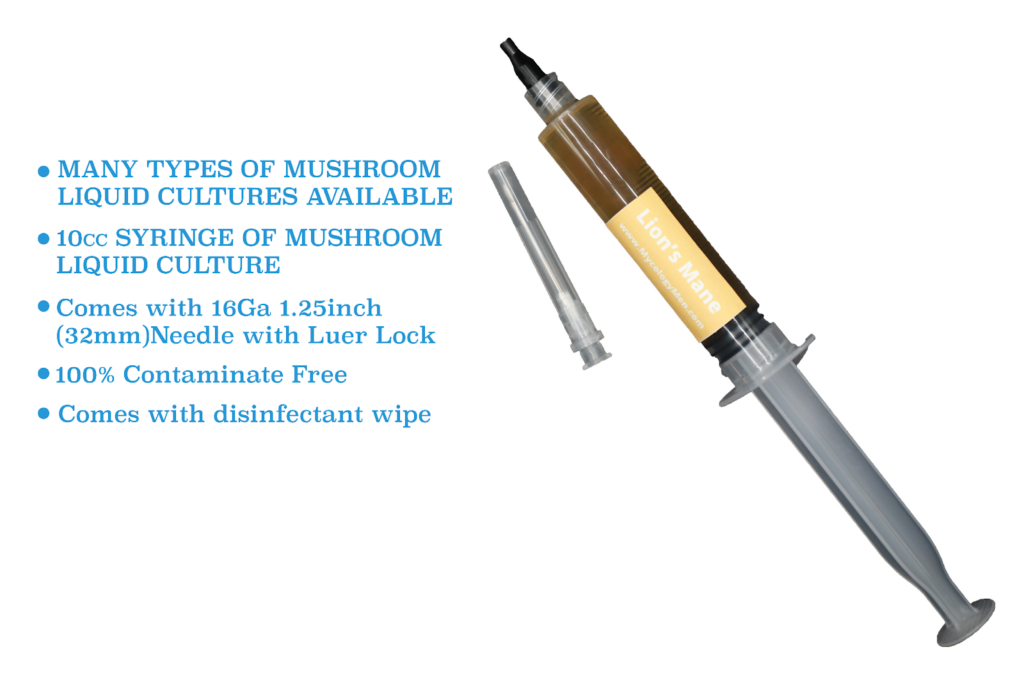
Welcome to the wonderful world of fungi! If you are just getting started on your mushroom journey or a practiced cultivator, knowing the difference between liquid culture vs spore syringe is an essential part of developing a wider knowledge base. Growing mushrooms always begins with one or the other. In this article we will talk about a variety of topics including: what is a liquid culture, what are mushroom spores, what are the differences between the two, which is better for beginners, which work faster, and even how to make liquid cultures from spores. We are so excited to have you along for the ride! Now, let’s get it started on the discussion of liquid culture vs spore syringe!
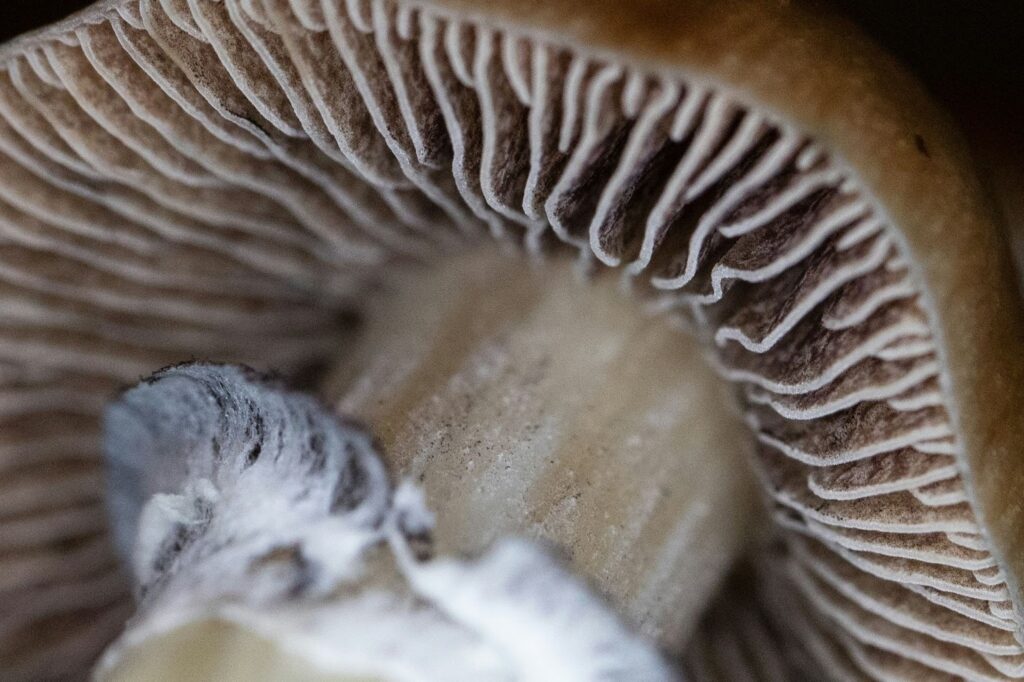
Photo by Christopher Cassidy on Unsplash
It’s alive! Frankenstein reference aside, liquid cultures actually do contain actively growing mycelium. The mycelium is suspended in a nutrient-rich liquid broth and stored in a large syringe. Inside the syringe you will see a cloudy collection - this is your mycelium! The liquid it hangs out in is a sterile sugar solution which is the perfect environment for mycelium to thrive.
Liquid cultures are preferred by many growers because they colonize faster than spores do (we will get into why that is in the next section). Done correctly with proper sterilization techniques, liquid cultures also have lower contamination rates. Another benefit you may consider is that liquid cultures are genetically stable. This means that each grow will be the same.
The risk with liquid cultures is that if there is bacteria present, the contamination will spread like wildfire. Growers need to really have their sterilization techniques locked in to successfully use liquid cultures.
There is no shortage of producers online with liquid cultures for sale. Try and find a company with good reviews and helpful tips that can guide you on your mushroom growing journey.
Mushroom spores are the blueprint from which your fungi will grow. You can think of them as mushroom seeds (to be clear, they are definitely not seeds, just the starting place for mushrooms). The key difference between mushroom spores and liquid cultures is that mushroom spores are dormant. This means there is no actively growing mycelium present like there is in a liquid culture.
Spores are released from the gills, teeth, and pores of mature mushrooms. Just shaking a mushroom cap can release millions of spores. Each spore contains half of the genetic material necessary to grow a mushroom. Two spores must be matched together before you can start growing mushrooms.
Once the spores are collected on a sterile surface, they can be rehydrated then stored in syringes. People like spores because they have a relatively long shelf life compared to liquid cultures. They are also preferred by some growers because each set of spores is entirely unique. This genetic diversity allows practiced growers to cultivate different lines of the same mushroom strain in which they look for preferred qualities such as harvest yield, grow rate, flavor, and more.
One downside of using spores is the same as what some might consider an upside: the genetic diversity. You never know what you are going to get out of a grow until you actually grow it. While this may be exciting for some, for others it is just a pain. Aside from that, spores will grow slower than liquid cultures because they start as dormant so they need to be germinated. Liquid cultures on the other hand are already actively growing. Finally, spores have a higher contamination rate than liquid cultures.
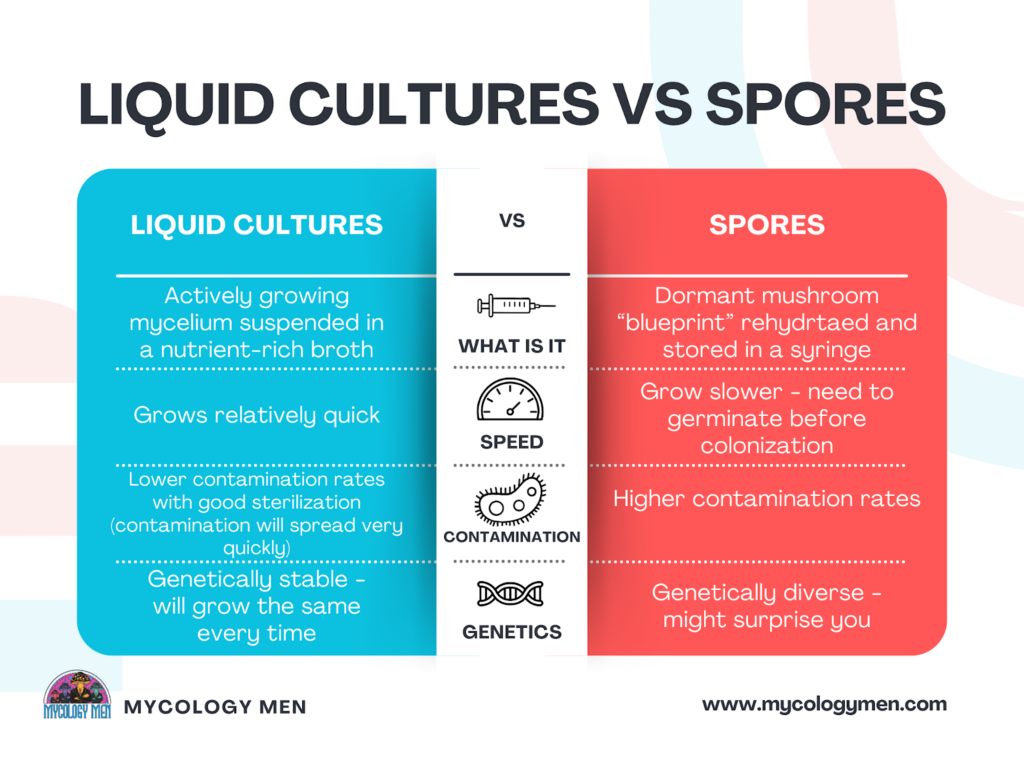
The answer to this question on liquid culture vs spore syringe really depends on your goals.
If you want fast, reliable, and low-contamination risk growing, use liquid cultures.
If you want to learn sterile techniques and experiment with different genetics, use spores.
As we described above, liquid cultures grow faster than spores, are genetically stable so the results are consistent, and they have a lower risk of contamination (assuming you follow proper sterilization techniques).
Spores on the other hand are genetically diverse so they are great for experimenting with genetic differences within a strain. They also force you to learn about sterilization techniques as contamination is a serious concern.
Spores run a high risk of contamination for a number of reasons. They are definitely more contaminant-prone than liquid cultures. The reason for this is that the spores are more likely to be contaminated during the collection process because this is done out in the open and not necessarily in a sterile environment. Spores then battle for resources with bacteria and mold. And they will lose that battle every single time because spores are dormant and the germination process is quite slow. Not only that, but spore syringes often contain microscopic contaminants already. It is really an uphill battle, but it can be done with proper training and techniques.
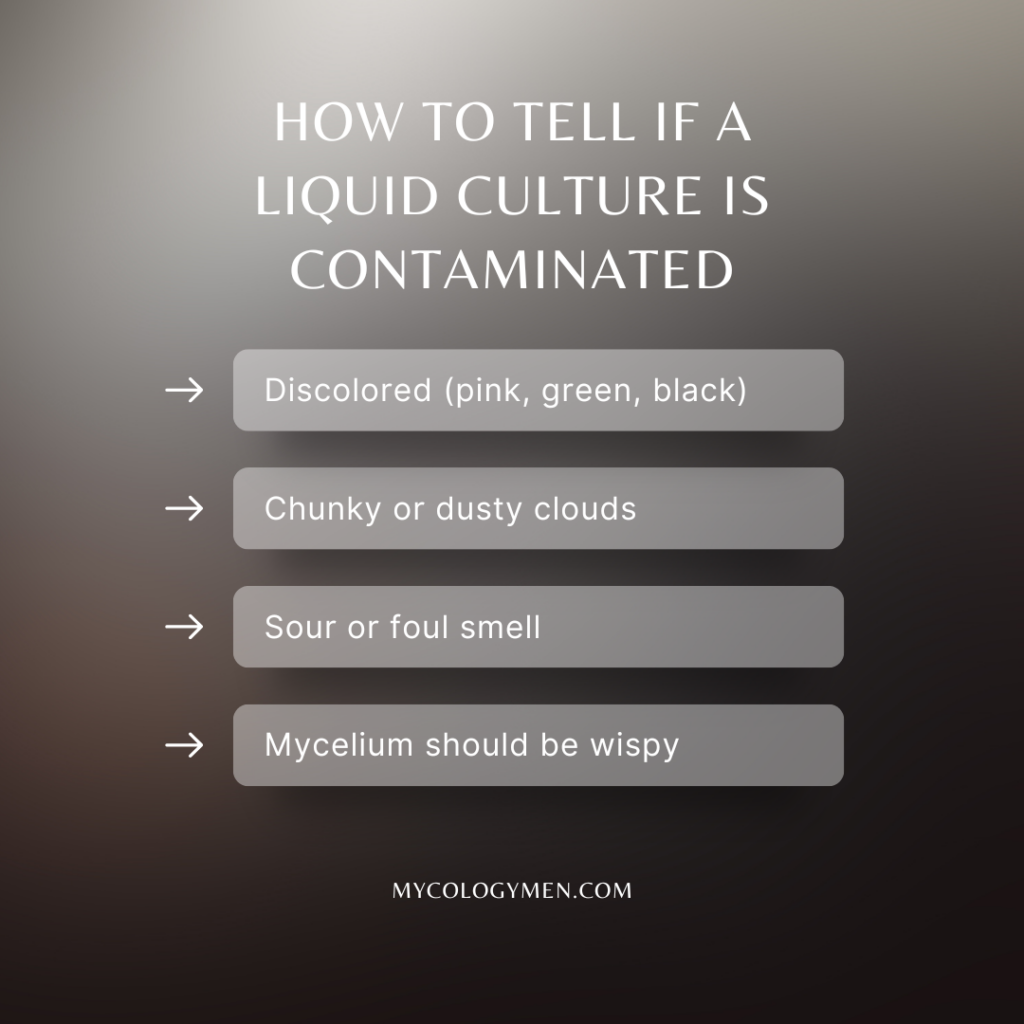
There are a few tell-tale signs you can keep an eye out for to determine if your liquid culture is contaminated. First off, if the syringe liquid is discolored at all (green, pink, black) it is probably contaminated. Secondly, the mycelium should be like wispy strands - anything else can mean contamination. This means dusty or chunky clouds are probably contaminated. Finally, and this one should be obvious, if it smells sour or downright awful, it is probably contaminated.
Liquid cultures will get to harvest substantially faster than spores will. This is because spores are dormant to start and need to germinate before colonization. Liquid cultures on the other hand are actively growing while still in the syringe.